The Soviet wall posters hanging inside the game's bases, line by line: agitprop that tells the soldier how to behave, training posters that teach a weapon, and the stencilled warnings on a generator's doors. Tap the button to hear it.
0.90x
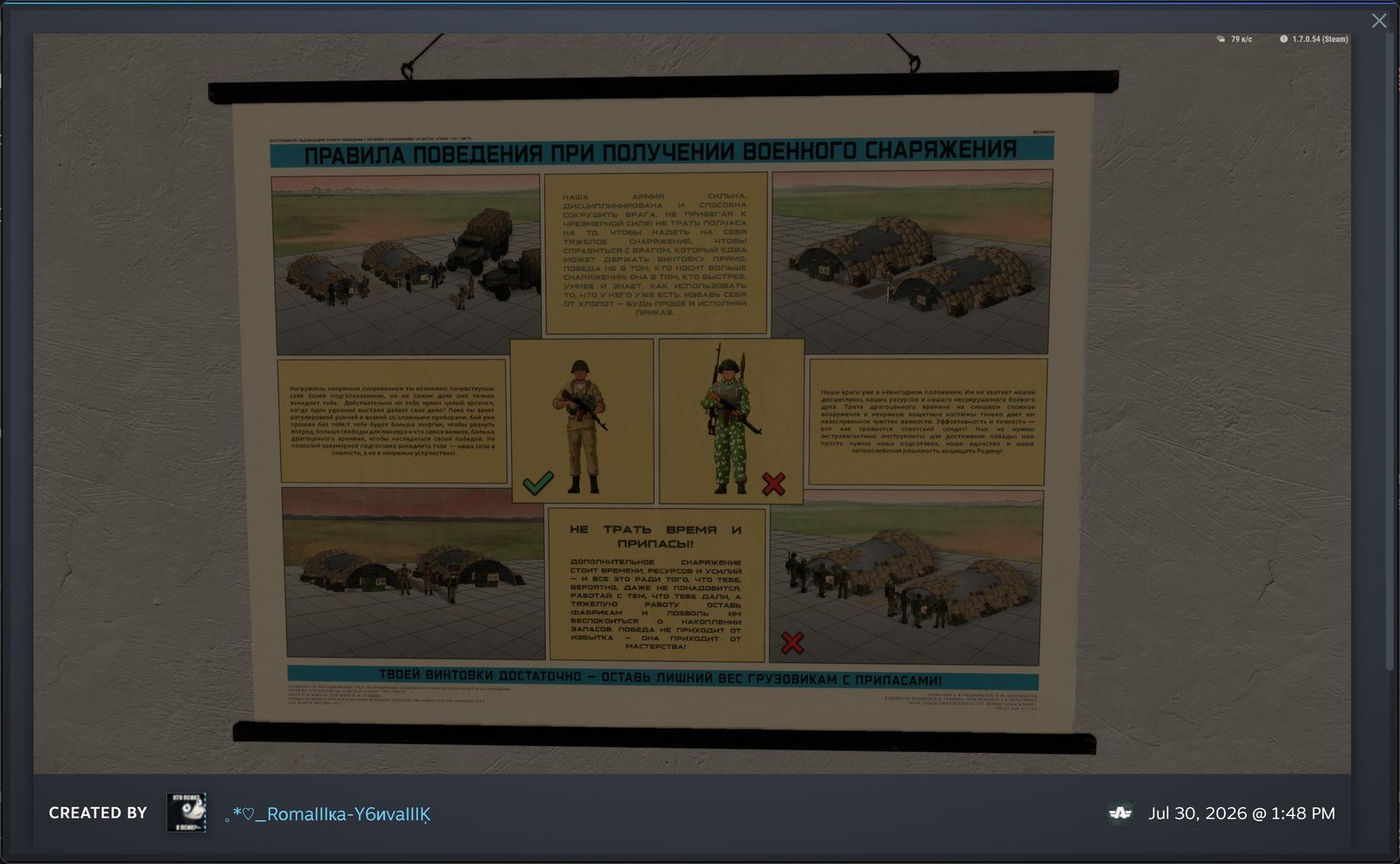
Rules of Conduct for Receiving Military Equipment
Poster Text
Пра́вилаповеде́ния при получе́ниивое́нногоснаряже́ния.
Rules of Conduct for Receiving Military Equipment (poster title)
ACCприка́з · Dictionary прика́з (masc., "order/command"); Direct object of исполня́й ("carry out").
Нагружа́ясь нену́жным снаряже́нием ты возмо́жно почу́вствуешь себя́ бо́лее подгото́вленным, но на само́м де́ле оно́ то́лько заме́длит тебя́.
Loading yourself down with unnecessary gear, you might feel more prepared, but in reality it will only slow you down. (left column text)
Нагружа́ясь · Gerund of нагружа́ться (impf., reflexive, "to load oneself down"), sets up the whole first sentence.
INSснаряже́нием · Dictionary снаряже́ние (neut., "gear"), instrumental; Нагружа́ться takes instrumental for what you're loading yourself with.
The poster prints its first sentence without two commas that standard punctuation would add: one closing the gerund phrase after снаряже́нием, and a pair around the parenthetical возмо́жно ("Нагружа́ясь нену́жным снаряже́нием, ты, возмо́жно, почу́вствуешь…"). This line follows the poster as printed.
Действи́тельно ли тебе́ ну́жен це́лый арсена́л, когда́ оди́н уда́чный вы́стрел де́лает своё де́ло?
Do you really need a whole arsenal when one good shot does the job?
"Тебе́ ну́жен X (nominative)" · Fixed construction: the person needing something is dative, the thing needed is nominative, here це́лый арсена́л ("a whole arsenal").
Пока́ ты за́нят регулиро́вкойремне́й и вознёй со сло́жными прибо́рами, бой прошёл без тебя́.
While you're busy adjusting straps and fiddling with complicated gadgets, the battle has passed you by.
INSрегулиро́вкой · Dictionary регулиро́вка (fem., "adjustment"), instrumental; "За́нят" (busy) takes instrumental for what you're busy with.
У тебя́ бу́дет бо́льше эне́ргии, что́бы рвану́ть вперёд, бо́льше свобо́ды для манёвра и что са́мое ва́жное, бо́льше драгоце́нного вре́мени, что́бы наслади́ться свое́й побе́дой.
You'll have more energy to charge forward, more freedom to maneuver and, most importantly, more precious time to enjoy your victory.
GENэне́ргии, свобо́ды, вре́мени · Genitive after the comparative бо́льше ("more of"), the same partitive-genitive pattern repeated three times in one sentence.
Не позво́ль чрезме́рной подгото́вке заме́длить тебя́: на́ша си́ла в сме́лости, а не в нену́жных устро́йствах!
Don't let over-preparation slow you down: our strength is in courage, not in unnecessary gadgets!
заме́длить · Infinitive (pf., "to slow down"), governed by "Не позво́ль X (dative) Y (infinitive)," i.e. "don't let X do Y."
PREPсме́лости / устро́йствах · Dictionary сме́лость (fem., "courage") and устро́йство (neut., "device"), both prepositional after "в" (in).
На́ши враги́ уже́ в невы́годном положе́нии.
Our enemies are already at a disadvantage. (right column text)
PREPположе́нии · Dictionary положе́ние (neut., "position/situation"), prepositional; "В" for state/situation.
Им не хвата́ет на́шей дисципли́ны, на́ших ресу́рсов и на́шего несокруши́мого боево́го ду́ха.
They lack our discipline, our resources and our unbreakable fighting spirit.
хвата́ет · 3rd sg of хвата́ть (impf., "to be lacking/sufficient"), impersonal, governs genitive for the thing lacked.
GENдисципли́ны, ресу́рсов, ду́ха · Genitive objects of хвата́ет, each modified by на́шей/на́ших/на́шего ("our").
Тра́та драгоце́нного вре́мени на сли́шком сло́жное вооруже́ние и нену́жные защи́тные костю́мы то́лько даёт им незаслу́женное чу́вство ва́жности.
Wasting precious time on overly complex weapons and unnecessary protective suits only gives them an undeserved sense of importance.
ACCвооруже́ние / костю́мы · Dictionary вооруже́ние (neut., "weaponry") and костю́м (masc.), accusative; Objects of the implied "spending time on."
Эффекти́вность и то́чность.
Efficiency and precision.
Вот как сража́ется сове́тский солда́т!
That's how the Soviet soldier fights!
NOMсолда́т · Dictionary солда́т (masc., "soldier"), nominative; Subject of сража́ется.
Нам не нужны́ экстравага́нтные инструме́нты для достиже́ния побе́ды; нам про́сто нужны́ на́ша подгото́вка, на́ше еди́нство и на́ша непоколеби́мая реши́мость защища́тьРо́дину!
We don't need extravagant tools to achieve victory; we simply need our training, our unity and our unshakable resolve to defend the Motherland!
"Нам не нужны́ X (nominative plural)" · Same dative-experiencer + nominative-subject construction as ну́жен above, plural agreement (нужны́) since инструме́нты is plural.
Дополни́тельное снаряже́ние сто́итвре́мени, ресу́рсов и уси́лий, и всё э́то ра́ди того́, что тебе́, вероя́тно, да́же не пона́добится.
Extra gear costs time, resources and effort, and all for something you probably won't even need. (bottom panel text, under the "Don't Waste Time and Supplies!" heading)
сто́ит · 3rd sg of сто́ить (impf., "to cost"), governs genitive for the price/cost, here three genitives in a row: вре́мени, ресу́рсов, уси́лий.
"Ра́ди того́, что..." · Fixed construction, "for the sake of what/that which..."
Рабо́тай с тем, что тебе́ да́ли, а тяжёлую рабо́туоста́вьфа́брикам и позво́ль им беспоко́иться о накопле́нии запа́сов.
Work with what you've been given, and leave the hard work to the factories and let them worry about stockpiling supplies.
ACCрабо́ту · Dictionary рабо́та (fem., "work/job"); Direct object of оста́вь.
DATфа́брикам · Dictionary фа́брика (fem., "factory"), dative plural; Indirect object of оста́вь ("leave to the factories").
GENзапа́сов · Dictionary запа́с (masc., "stock/supply"), genitive plural; Object of "о накопле́нии" ("about the stockpiling of").
RPG-7V Hand-Held Anti-Tank Grenade Launcher (poster heading, which misprints the second word as противотитанковый)
NOMРучно́й ("hand-held") · Agrees with гранатомёт, nominative masculine. From рука́ ("hand").
NOMпротивота́нковый ("anti-tank") · Agrees with гранатомёт, nominative masculine. Built from про́тив ("against") and танк.
NOMгранатомёт · Dictionary гранатомёт (masc., "grenade launcher"); Head noun of the heading, nominative. Built from грана́та and мета́ть ("to hurl").
NOMРПГ · Read as letters: эр-пэ-гэ семь вэ. РПГ stands for the three words before it, Ручно́й Противота́нковый Гранатомёт, so the heading spells its own acronym out.
The poster's heading prints ПРОТИВОТИТАНКОВЫЙ, with a stray ТИ. Its own description box spells the word correctly, and that is the form taught here.
The heading is in capitals and prints гранатомет without the ё. The ё is restored so the audio says the real word.
Сорокамиллиметро́выйгранатомётРПГ-7В, предназна́чен для пораже́нияброневы́хце́лей, огневы́хто́чек и живо́йси́лыврага́.
The 40 mm RPG-7V grenade launcher, designed to defeat armoured targets, firing positions and enemy personnel (shortened to 40-мм on the poster)
NOMСорокамиллиметро́вый ("40 mm") · Agrees with гранатомёт, nominative masculine. The poster prints it as 40-мм, where мм is short for миллиме́тр.
NOMгранатомёт · Dictionary гранатомёт (masc., "grenade launcher"); Subject of the sentence, nominative.
NOMРПГ · A model designation standing in apposition to its noun. It never declines, whatever case the noun beside it takes.
предназна́чен · From предназна́чить (pf., "to intend, to design for"); Short-form masculine passive participle: "is intended." What it is intended for follows as для plus the genitive.
GENпораже́ния · Dictionary пораже́ние (neut., "defeat, hitting a target"); Genitive after для ("for"), which always takes it.
GENброневы́х ("armoured") · Agrees with це́лей, genitive plural.
GENце́лей · Dictionary цель (fem., "target"); Genitive plural, depending on пораже́ния: "the defeat of targets."
GENогневы́х ("fire, firing") · Agrees with то́чек, genitive plural.
GENто́чек · Dictionary то́чка (fem., "point"); Genitive plural, with the fleeting е that appears when the ending drops. Огнева́я то́чка is the set term for a firing position or weapon emplacement.
GENживо́й ("living") · Agrees with си́лы, genitive feminine singular.
GENси́лы · Dictionary си́ла (fem., "force"); Genitive singular. Жива́я си́ла ("living force") is the fixed military term for personnel, as opposed to vehicles and equipment.
NOMВы́стрел · Dictionary вы́стрел (masc., "shot; round"); Nominative. In everyday speech a вы́стрел is a shot. For a grenade launcher or artillery piece it is the complete round, the grenade together with its propellant charge.
NOMПГ · Read as letters: пэ-гэ семь вэ. The poster does not spell the letters out, so they are not expanded here.
По́сле взво́да.
After Arming (the upper round, with its fins unfolded)
GENвзво́да · Dictionary взвод (masc., "cocking, arming"); Genitive after по́сле ("after"), which always takes it. The same word взвод also means a platoon.
До взво́да.
Before Arming (the lower round, with its fins folded)
GENвзво́да · Dictionary взвод (masc., "cocking, arming"); Genitive after до ("before, up to"), which always takes it.
Описа́ниегранатомёта.
Description of the Grenade Launcher (box heading)
NOMОписа́ние · Dictionary описа́ние (neut., "description"); Head noun of the box heading, nominative. From описа́ть ("to describe").
GENгранатомёта · Dictionary гранатомёт (masc., "grenade launcher"); Genitive: "description of the launcher."
Ручно́йпротивота́нковыйгранатомётмногора́зовогопримене́ния, предназна́чен для борьбы́ с брониро́ваннымисре́дствамипроти́вника.
A reusable hand-held anti-tank grenade launcher, intended for fighting the enemy's armoured assets. (description box)
NOMРучно́й ("hand-held") · Agrees with гранатомёт, nominative masculine.
NOMпротивота́нковый ("anti-tank") · Agrees with гранатомёт, nominative masculine. Spelled correctly here, unlike in the poster's heading.
NOMгранатомёт · Dictionary гранатомёт (masc., "grenade launcher"); Subject of the first sentence, and again of the third. Nominative both times.
GENмногора́зового ("reusable") · Agrees with примене́ния, genitive neuter. From мно́го ("many") and раз ("time").
GENпримене́ния · Dictionary примене́ние (neut., "use, application"); A genitive of description: literally "of reusable use."
предназна́чен · From предназна́чить (pf., "to intend, to design for"); Short-form masculine passive participle: "is intended."
GENборьбы́ · Dictionary борьба́ (fem., "fight, struggle"); Genitive after для. Борьба́ с plus the instrumental means a fight against something.
INSброниро́ванными ("armoured") · Agrees with сре́дствами, instrumental plural. The stress matters: брони́рованный, stressed earlier, means "booked" or "reserved."
INSсре́дствами · Dictionary сре́дство (neut., "means, asset"); Instrumental plural after с.
GENпроти́вника · Dictionary проти́вник (masc., "adversary, enemy"); Genitive singular: "the enemy's." The poster uses it twice. It is the formal military word, where the subtitle above uses the plainer враг.
Standard punctuation would drop the comma after примене́ния. The poster's own comma is kept.
Кро́ме того́, онмо́жетбытьиспо́льзован для уничтоже́нияживо́йси́лыпроти́вника, находя́щейся в лёгкихукры́тиях, а та́кже в сооруже́нияхгородско́готи́па.
Besides that, it can be used to destroy enemy personnel located in light cover, as well as in urban-type structures.
Кро́ме того́ ("besides, moreover") · Literally "apart from that": the preposition кро́ме with the genitive of то.
NOMон · Dictionary он (pronoun, "he, it"); Nominative. It stands for гранатомёт, a masculine noun, so English says "it."
мо́жет · From мочь (impf., "to be able, can"); Third person singular, present tense.
быть · From быть (impf., "to be"); Infinitive after мо́жет. With the short participle that follows it forms a passive: "can be used."
испо́льзован · From испо́льзовать (impf. and pf., "to use"); Short-form masculine passive participle: "used."
GENуничтоже́ния · Dictionary уничтоже́ние (neut., "destruction"); Genitive after для.
GENживо́й ("living") · Agrees with си́лы, genitive feminine singular.
GENси́лы · Dictionary си́ла (fem., "force"); Genitive singular, depending on уничтоже́ния. Жива́я си́ла is the military term for personnel.
GENнаходя́щейся ("located, situated") · Present active participle, genitive feminine singular because it describes си́лы: "which is located." From находи́ться.
PREPлёгких ("light") · Agrees with укры́тиях, prepositional plural. The poster prints it without the ё.
та́кже ("also, as well") · With а before it, "as well as." The poster prints так-же both times, with a hyphen the word never takes.
PREPсооруже́ниях · Dictionary сооруже́ние (neut., "structure, building"); Prepositional plural after в.
GENгородско́го ("urban, city") · Agrees with ти́па, genitive masculine.
GENти́па · Dictionary тип (masc., "type"); A genitive of description: "of an urban type."
Гранатомёт снабжёнприце́ломПГО-7В, а та́кже резе́рвным, откры́тымприце́ломкалибро́ванным под грана́тыПГ-7ВМ на да́льности две́сти-пятьсо́т ме́тров.
The launcher is fitted with the PGO-7V sight, and also with a backup open sight calibrated for PG-7VM grenades at a range of 200 to 500 metres. (the range is printed in figures, and metres is shortened to м)
снабжён · From снабди́ть (pf., "to supply, to equip"); Short-form masculine passive participle: "is fitted." What it is fitted with goes in the instrumental.
INSприце́лом · Dictionary прице́л (masc., "sight"); Instrumental, required by снабжён. Used twice, once for each sight.
NOMПГО · A model designation standing in apposition to its noun. It never declines, whatever case the noun beside it takes. Read as letters: пэ-гэ-о семь вэ.
INSрезе́рвным ("backup, reserve") · Agrees with the second прице́лом, instrumental masculine.
INSоткры́тым ("open") · Agrees with прице́лом, instrumental masculine. An откры́тый прице́л is an open sight, what English calls iron sights.
INSкалибро́ванным ("calibrated") · Past passive participle, instrumental masculine, describing прице́лом. The poster misprints it with a single н, калиброваным. From калиброва́ть.
ACCграна́ты · Dictionary грана́та (fem., "grenade"); Accusative plural after под, here "made to suit." Inanimate, so it matches the nominative plural.
NOMПГ · A model designation standing in apposition to its noun. It never declines, whatever case the noun beside it takes.
ВМ ("VM") · The closing letters of the grenade's designation, read вэ-эм. The poster does not say what they stand for.
PREPда́льности · Dictionary да́льность (fem., "range, distance"); Prepositional singular after на: "at a range."
две́сти-пятьсо́т ("200, 500") · Printed in figures on the poster, 200 and 500 joined by a dash. A range of two numbers is read aloud one after the other.
GENме́тров · Dictionary метр (masc., "metre"); Genitive plural, required by пятьсо́т, as after every number from five up. The poster abbreviates it to м.
Standard punctuation would drop the comma after резе́рвным and add one before калибро́ванным. The poster's own commas are kept.
При стрельбе́, по́мни об обра́тнойвзрывно́йволне́, опа́сной для находя́щихся позади́!
When firing, remember the backblast, dangerous to those standing behind! (warning at the foot of the description box)
PREPстрельбе́ · Dictionary стрельба́ (fem., "firing, shooting"); Prepositional after при, here "during, when."
по́мни · From по́мнить (impf., "to remember"); The ты imperative, the informal singular that Soviet posters address the soldier with. По́мнить о takes the prepositional.
PREPобра́тной ("reverse, backward") · Agrees with волне́, prepositional feminine.
PREPвзрывно́й ("blast, explosive") · Agrees with волне́, prepositional feminine. From взрыв ("explosion").
PREPволне́ · Dictionary волна́ (fem., "wave"); Prepositional after об, the form о takes before a vowel. Взрывна́я волна́ is a blast wave, and the обра́тная one is the backblast out of the rear of the tube.
PREPопа́сной ("dangerous") · Agrees with волне́, set off after it by a comma. Опа́сный для takes the genitive.
GENнаходя́щихся · Dictionary находи́ться (impf. participle, "those who are (somewhere)"); Present active participle used as a noun, genitive plural after для: "for those who are."
позади́ ("behind") · Says where those people are standing.
Standard punctuation would not put a comma after стрельбе́. The poster's own is kept.
Техни́ческиеда́нные.
Technical Data (table heading)
NOMТехни́ческие ("technical") · Agrees with да́нные, nominative plural.
NOMда́нные · Dictionary да́нные (plural only, "data"); Nominative. A participle of дать ("given things") that became a noun, and it exists only in the plural.
The table under this heading lists length, mass, calibre, rate of fire, ranges and velocities. Its figures are too small to read reliably in this screenshot, so its rows are not transcribed here.
Основны́ебоевы́еполномо́чия.
Main Combat Features (literally "main combat powers"; heading of the parts diagram)
NOMОсновны́е ("main, basic") · Agrees with полномо́чия, nominative plural.
NOMбоевы́е ("combat") · Agrees with полномо́чия, nominative plural. From бой ("battle").
NOMполномо́чия · Dictionary полномо́чие (neut., "authority, power to act"); Nominative plural. The word normally means legal or official authority, so it reads oddly over a diagram of parts. The panel under it labels the launcher's components.
Labelled Parts
Опти́ческийприце́лПГО-7.
PGO-7 Optical Sight
NOMОпти́ческий ("optical") · Agrees with прице́л, nominative masculine.
NOMприце́л · Dictionary прице́л (masc., "sight"); Head noun, nominative. From це́лить ("to aim"), like цель ("target").
NOMПГО · Read as letters: пэ-гэ-о семь. The poster does not expand the letters. The game's field manual lists the fitted model as the ПГО-7В3 and calls it a Soviet optical sight designed for the RPG-7.
Откидно́йце́лик.
Folding Rear Sight
NOMОткидно́й ("folding, flip-up") · Agrees with це́лик, nominative masculine. From отки́нуть ("to flip back").
NOMце́лик · Dictionary це́лик (masc., "rear sight"); Nominative. The notched rear half of open sights, from the same root as цель.
Откидна́яму́шка.
Folding Front Sight
NOMОткидна́я ("folding, flip-up") · Agrees with му́шка, so nominative feminine this time.
NOMму́шка · Dictionary му́шка (fem., "front sight"); Nominative. Literally "little fly," the diminutive of му́ха. Взять на му́шку, "to take onto the front sight," means to draw a bead on someone.
Деревя́нныйкожу́х (теплозащи́тный).
Wooden Shroud (heat-shielding)
NOMДеревя́нный ("wooden") · Agrees with кожу́х, nominative masculine. From де́рево ("wood, tree").
NOMкожу́х · Dictionary кожу́х (masc., "casing, shroud"); Nominative. The wooden sleeve around the tube that keeps the firer's shoulder and cheek off the hot metal.
NOMтеплозащи́тный ("heat-shielding") · Agrees with кожу́х, nominative masculine. Built from тепло́ ("heat") and защи́та ("protection").
Растру́б.
Flared Bell (the cone at the rear of the tube)
NOMРастру́б · Dictionary растру́б (masc., "flared bell, bell mouth"); Nominative. From труба́ ("pipe, trumpet"): any tube end that widens like the bell of a trumpet.
Дополни́тельнаярукоя́тка.
Additional Grip
NOMДополни́тельная ("additional") · Agrees with рукоя́тка, nominative feminine.
NOMрукоя́тка · Dictionary рукоя́тка (fem., "grip, handle"); Nominative. From рука́ ("hand"). This is the rear grip the firer's second hand holds.
Рукоя́тка и уда́рно-спусково́ймехани́зм.
Grip and Trigger Mechanism
NOMРукоя́тка · Dictionary рукоя́тка (fem., "grip, handle"); Nominative, the first of two labelled parts joined by и.
NOMуда́рно-спусково́й ("striker-and-trigger") · Agrees with механи́зм, nominative masculine. Built from уда́р ("strike") and спуск ("trigger release").
NOMмехани́зм · Dictionary механи́зм (masc., "mechanism"); Nominative. Уда́рно-спусково́й механи́зм is the standard firearms term for the trigger group, and the game's own safety tips use it.
Carbon Monoxide Warning Stencil
Stencil Text
Внима́ние!
Warning! (stencilled on a metal door panel)
NOMВнима́ние · Dictionary внима́ние (neut., "attention"), nominative; The standard opening word of a Russian warning sign, the way English signs open with "Caution!"
Не испо́льзовать в ка́чествеукры́тия.
Do not use as a shelter.
испо́льзовать · Infinitive (impf. and pf., "to use"). Не with an infinitive is the impersonal prohibition of signs and instructions: it addresses nobody in particular, so it needs no ты or imperative.
PREPка́честве · Dictionary ка́чество (neut., "quality"), prepositional; "В ка́честве" plus a genitive is a fixed phrase meaning "as, in the role of", literally "in the quality of".
GENукры́тия · Dictionary укры́тие (neut., "shelter, cover"); Genitive after в ка́честве. It is also the soldier's word for cover: the game's own tutorial says "используй её в качестве укрытия" ("use it as cover") about a wall.
Мо́жетпроизойти́отравле́ниеокси́домуглеро́да.
Carbon monoxide poisoning may occur. (broken Russian on the panel, taught here corrected)
мо́жет · 3rd person singular of мочь (impf., "can, may").
произойти́ · Infinitive (pf., "to happen, to occur"), governed by мо́жет.
NOMотравле́ние · Dictionary отравле́ние (neut., "poisoning"); Subject of мо́жет произойти́, placed after the verb because Russian puts the new information last.
INSокси́дом · Dictionary окси́д (masc., "oxide"), instrumental; What someone is poisoned by goes in the instrumental, as in отрави́ться гриба́ми ("to be poisoned by mushrooms").
GENуглеро́да · Dictionary углеро́д (masc., "carbon"), genitive; "Окси́д углеро́да" is literally "oxide of carbon", the chemist's name for carbon monoxide.
In everyday speech carbon monoxide is уга́рный газ, from уга́р (the fumes of a badly drawn stove), so a native warning would just as often read "Возмо́жно отравле́ние уга́рным га́зом."
The panel actually reads "Возможный углерод отравление оксидом может произойти", which is the English "possible carbon monoxide poisoning may occur" set down word for word in English order. Three things are wrong: углерод is left in the nominative where it must be genitive углерода after оксидом; возможный ("possible") is a masculine adjective that matches no noun (отравление is neuter); and it repeats what может already says. Dropping возможный and reordering gives the line taught here, keeping the panel's other five words.
Hearing Protection Stencil
Stencil Text
Предупрежде́ние: при откры́тыхдверя́хтре́буетсязащи́таслу́ха.
Warning: hearing protection is required when the doors are open. (broken Russian on the panel, taught here corrected)
NOMПредупрежде́ние · Dictionary предупрежде́ние (neut., "warning"), nominative; The label that opens a sign, a step stronger than the CO stencil's Внима́ние! ("Attention!"). Its verb is предупреди́ть, "to warn".
PREPоткры́тых ("open") · Agrees with дверя́х, prepositional plural; The past passive participle of откры́ть ("to open"), used as an adjective.
PREPдверя́х · Dictionary дверь (fem., "door"), prepositional plural; При with the prepositional sets a condition, "when, in the presence of", so при откры́тых дверя́х is "with the doors open". The plural moves the stress onto the ending: дверь, but двере́й, дверя́м, дверя́х.
тре́буется · 3rd person singular of тре́боваться (impf., "to be required"), the reflexive passive of тре́бовать ("to demand"); The stock word of notices and job ads: "Тре́буется продаве́ц" means "Shop assistant wanted".
NOMзащи́та · Dictionary защи́та (fem., "protection"), nominative; Subject of тре́буется, placed after the verb because Russian puts the new information last.
GENслу́ха · Dictionary слух (masc., "hearing"), genitive; What is protected goes in the genitive: защи́та слу́ха, "protection of hearing". A formal Russian safety sign says сре́дства защи́ты о́рганов слу́ха ("means of protecting the organs of hearing").
The panel actually reads "Предупреждение: слух требуется защита с открытыми дверями", the English "Warning: hearing protection required with doors open" set down word for word. Слух is left in the nominative in front of требуется, where it must follow защита in the genitive, слуха, so the panel literally says "Warning: hearing is required, protection, with open doors". С откры́тыми дверя́ми is grammatical on its own, but a sign states its condition with при and the prepositional, so the line taught here keeps the panel's nouns and verb and mends the case and the order.
Output Terminals Stencil
Stencil Text
Выходны́екле́ммы
Output terminals
NOMВыходны́е ("output") · Agrees with кле́ммы, nominative plural; From вы́ход ("exit, way out"). As a noun, выходны́е also means "the weekend", from выходно́й день ("a day off"), so the same word labels this hatch and Saturday.
NOMкле́ммы · Dictionary кле́мма (fem., "terminal, clamp"), nominative plural; Borrowed from the German Klemme. The clamps on a car battery's posts are кле́ммы too.
Предупрежде́ние: смерте́льноенапряже́ние.
Warning: lethal voltage. (the panel says "therapeutic voltage", taught here corrected)
NOMПредупрежде́ние · Dictionary предупрежде́ние (neut., "warning"), nominative; The same label as on the hearing protection door.
NOMсмерте́льное ("lethal, deadly") · Agrees with напряже́ние, neuter nominative; From смерть ("death").
NOMнапряже́ние · Dictionary напряже́ние (neut., "voltage; tension, strain"); The electrician's word for voltage and the everyday word for strain or tension: высо́кое напряже́ние is "high voltage".
The panel actually says лече́бное напряже́ние, "therapeutic voltage". Лече́бный ("healing, medicinal") comes from лечи́ть ("to treat, to cure"), and the translator seems to have mistaken it for the English "lethal". Лета́льный does exist, but only in medical writing (лета́льный исхо́д, "a fatal outcome"); a warning sign says смерте́льное or опа́сно для жи́зни ("dangerous to life").
The classic Russian sign on electrical equipment reads "Осторо́жно! Высо́кое напряже́ние", and Soviet-era ones add "Не влеза́й, убьёт!" ("Don't climb in, it'll kill you!") under a lightning bolt.